

 Facebook
 X
 Pinterest
 Copy Link
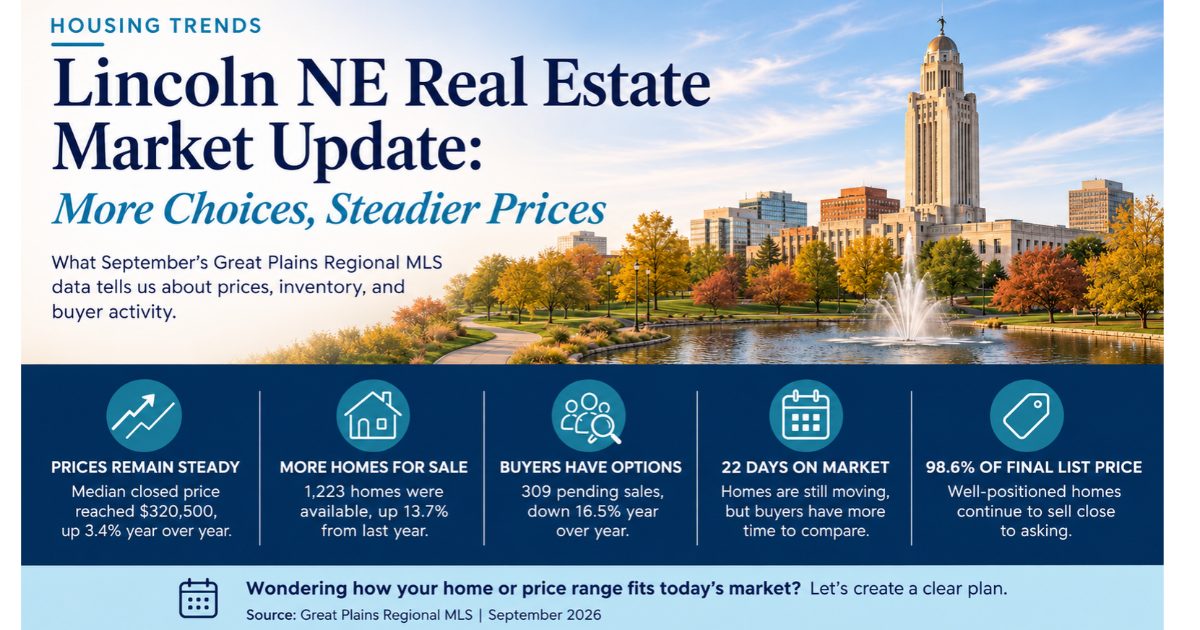
The latest real estate market data for Lincoln Nebraska shows that buyers have more homes to consider, while prices remain steady.
There is always a point in early fall when the pace begins to change. Evenings arrive a little sooner. School and sportsl fill the calendar. The housing market also settles into a different rhythm. That shift appeared in Lincoln’s September 2026 housing numbers. Homes are still selling, and prices remain higher than they were a year ago. However, inventory has grown, pending sales have slowed, and buyers have more time to compare their options. This is not a market that has stopped moving. It is simply moving more thoughtfully.
Three Numbers That Tell the Story
Across the Lincoln Area:
- The median closed price reached $320,500 up 3.4% from September 2025.
- The number of homes for sale increased to 1,223, up 13.7% year over year.
- Pending sales fell to 309, down 16.5% from last September.
Together, these numbers show a market that is still holding its value, even as buyers move with less urgency. There were 817 new listings in September, compared with 826 one year earlier. During the month, 354 sales closed. Homes are continuing to enter the market, but buyers are purchasing them at a slower pace. As a result, inventory is gradually building. The slower pace is not limited to Lincoln. The National Association of REALTORS® reported that pending home sales declined across all four major U.S. regions during September. This does not mean buyers have disappeared. It suggests that affordability, financing, and having more homes to compare are giving many buyers reasons to make decisions carefully. Lincoln has its own local market patterns, but the broader trend is similar: buyers have more choices, and sellers need to pay closer attention to current competition.
Does More Inventory Mean It Is a Buyer’s Market?
Not necessarily. September ended with 3.2 months of housing supply, up from 2.8 months one year ago. That gives buyers more choices, but it does not place every neighborhood or price range in a buyer’s market.
Conditions can vary based on:
- Location
- Price range
- Property condition
- Home style
- Available competition
- New construction versus an existing home
Existing homes had 2.6 months of supply in September. New construction had 7.4 months. That is a meaningful difference. A well-maintained existing home in a desirable neighborhood may still receive quick attention. Meanwhile, a new construction home—or a property competing with several similar listings—may need more time or a stronger pricing strategy. Citywide numbers offer helpful direction. However, the smaller market surrounding an individual home often tells the more useful story.
Are Lincoln Home Prices Still Increasing?
Lincoln home prices remain steady. The September median closed price was $320,500, which was 3.4% higher than one year ago. Existing homes reached a median price of $301,750, up 4.1% from September 2025. The median price for new construction fell 9.5% to $398,225. However, that does not necessarily mean all newly built homes lost value. Still, the numbers suggest buyers are carefully comparing price with location, finishes, lot size, incentives, and the expenses that may remain after closing.
What Does the List Price Percentage Mean?
Across all properties, sellers received an average of 98.6% of their most recent list price. That remains a strong number, but there is an important detail to understand. The calculation compares the closing price with the home’s most recent asking price—not necessarily its original price. If a home started at $400,000, was reduced to $385,000, and then sold near $385,000, the sale would appear close to full price in this measurement. That is why the first price matters. A home that begins too high may receive fewer showings and spend more time on the market before reaching the price buyers recognize as fair.
How Quickly Are Homes Selling?
The average time from listing to an accepted offer was 22 days in September. That was unchanged from September 2025. Once again, the type of property made a difference. Existing homes averaged 19 days on the market. New construction averaged 52 days. For sellers, this means a home does not need to sell during its first weekend to be successful. However, the first few weeks should provide useful feedback.
Important questions include:
- Are buyers scheduling showings?
- Are they returning for a second look?
- Are similar homes going under contract?
- Is the online presentation creating interest?
- Does the price make sense beside the competition?
Those early signals can help determine whether the home’s price, condition, and presentation are working together.
What Does This Mean for Sellers?
A market with more choices rewards preparation. Buyers are more likely to notice deferred maintenance, unfinished projects, outdated features, and a price that sits above similar homes. Clean presentation, thoughtful marketing, and an informed starting price can make the decision easier for a buyer. Sellers should also look beyond the highest recent sale when choosing a price. Current listings, pending sales, recent price reductions, and homes that did not sell all provide valuable information.
What Does This Mean for Buyers?
More inventory gives buyers a little more breathing room, but it does not mean every home will wait. The strongest properties can still sell quickly, especially when they are well maintained and priced appropriately. Buyers benefit from having financing in place and knowing which features matter most before beginning their search. More choices can make it easier to compare homes. Clear priorities make it easier to recognize the right one.
One Question Worth Asking
Instead of asking only, “Is this a good time to buy or sell?” consider asking: How does my home, neighborhood, or price range fit into the market right now?
September’s numbers show a Lincoln-area market with steady prices, more available homes, and increasingly thoughtful buyers. There are opportunities for both buyers and sellers. However, those opportunities will not look the same for every household or property. If you are wondering how your home or next price range fits into today’s market, let’s talk it through.
No pressure. Just a plan.
Source: Great Plains Regional MLS Monthly Indicators for the Lincoln Area Region, reflecting September 2026 activity. The region includes Lancaster and Seward counties and selected surrounding ZIP codes. Market conditions vary by location, price range, property type, and condition.


