Facebook
 X
X
 Pinterest
 Copy Link
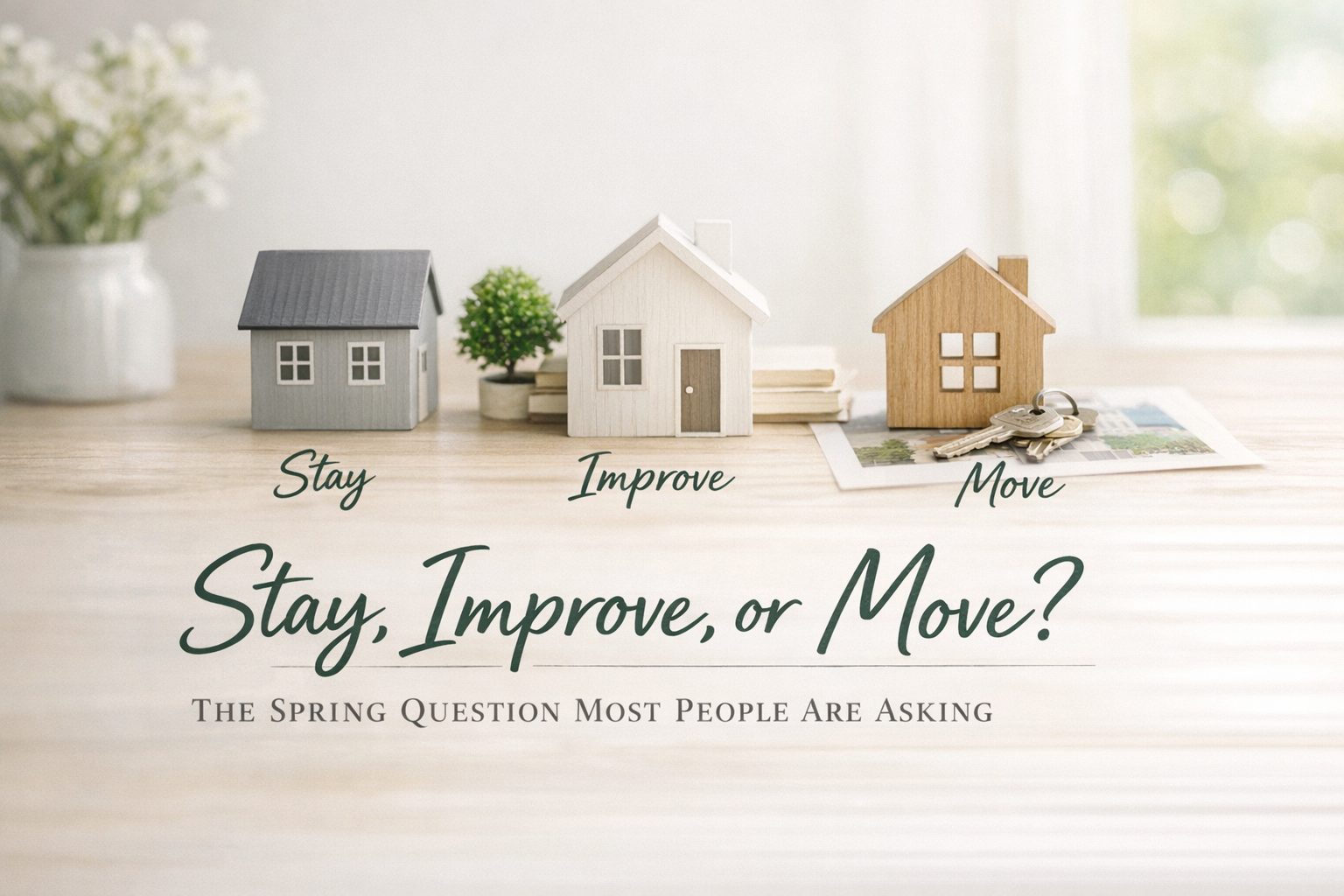
There’s something about spring that brings these questions to the surface.
Maybe it starts with a window cracked open after a long Nebraska winter. Maybe it shows up while clearing out a closet, walking through the yard, or noticing, again, that a room just doesn’t work the way it used to. Sometimes it arrives in a practical way. Sometimes it feels more personal than that.
But this time of year, I hear a version of the same question again and again:
Should we stay, improve, or move?
Not everyone asking it is ready to sell. In fact, most aren’t. Most are simply trying to make sense of what would actually feel best next — not just financially, but practically, emotionally, and day-to-day.
And honestly, that makes sense.
Because this decision is rarely just about real estate. It’s about how life feels in your home right now, and whether that still fits where you’re headed.
The question behind the question
When people say they’re wondering whether to move, they’re often asking something deeper.
They may be asking:
- Will this home still work for us in the next few years?
- Are we putting money into the right improvements, or just delaying a bigger decision?
- Would moving actually simplify life — or just create a different kind of stress?
- If we stay, can this home become what we need it to be?
- If we go, what would we really be moving toward?
That’s why this isn’t always a clean, immediate answer.
Some homes still fit beautifully, but need a few thoughtful changes. Others are good homes that no longer match the rhythm of the people living in them. And sometimes the issue isn’t the house itself. It’s timing, upkeep, layout, location, or simply the quiet realization that life has changed.
Sometimes staying is the right move
There are seasons when staying makes the most sense.
Sometimes the smartest decision is not to uproot everything, but to improve what you already have. That might mean rethinking a main-floor space, updating a bathroom, improving storage, changing how a room functions, or making the home easier to manage and enjoy.
For some homeowners, staying means protecting a low-stress routine they already love. For others, it means avoiding a move they don’t actually need to make.
And sometimes staying is not “settling.” It’s choosing clarity over momentum. It’s realizing that what you need may be a better plan, not a different address.
Sometimes improving is really a bridge decision
This is where many people get stuck.
They’re not ready to move today, but they know the house needs attention. The challenge is deciding whether those improvements are part of a long-term stay, or just a short-term patch on a home that no longer fits.
That distinction matters.
A thoughtful improvement can make staying easier and more enjoyable. But not every project is worth the time, cost, and energy if a move is already quietly on the horizon.
The goal is not to do everything. It’s to understand which changes truly support your next chapter — and which ones simply buy time.
Sometimes moving is less about space and more about fit
People often assume a move is about wanting more house, less house, newer finishes, more land, fewer stairs, or a different neighborhood.
Sometimes it is.
But often, moving is really about wanting life to feel more manageable, more aligned, or more intentional.
For one person, that means less maintenance. For another, it means more room to gather. For someone else, it means better function, better flow, or a home that reflects the way they live now — not the way they lived ten years ago.
The clearest moves usually aren’t driven by pressure. They come from recognizing that the current setup is asking for too much compromise.
Spring has a way of making the mismatch easier to see
There’s a reason these questions show up now.
Spring naturally invites people to take stock. You notice the deferred projects. You notice what feels crowded, underused, or harder than it should be. You notice what you’ve outgrown — and sometimes what you still deeply love.
It’s also the season when people are surrounded by noise. Advice from friends. Headlines about the market. Builder promotions. Renovation inspiration. Conversations that make everything feel more urgent than it needs to be.
But most people do not need more pressure.
They need a way to sort through the options calmly.
You do not have to decide all at once
This is one of the biggest misconceptions I see.
People often think that once they start asking whether they should move, they need to be ready with a full answer. They think exploring the question means committing to action.
It doesn’t.
You’re allowed to think before you decide.
You’re allowed to gather information before you make a move.
You’re allowed to look at the numbers, the lifestyle implications, the improvement costs, and the emotional side of the decision without forcing yourself into a timeline.
Sometimes one honest conversation removes months of mental clutter.
A simple way to think about it
If you’ve been circling this question, here are a few good places to start:
Stay if the home still fits your life with only minor changes, and the thought of moving feels more disruptive than helpful.
Improve if the right updates would meaningfully change how the home functions, and you can clearly see yourself benefiting from those changes for years to come.
Move if the home no longer supports the way you want to live, and the effort to keep making it work is starting to outweigh the comfort of staying.
The answer is not always obvious right away. But it usually becomes clearer when you stop treating the decision like a test and start treating it like a planning process.
A resource to help you sort through it
Because this question comes up so often, I put together a Stay or Go Guide for homeowners who want to think through their options without pressure.
It’s designed to help you look at the decision from a few different angles — lifestyle, timing, practicality, and what each path would actually mean day to day.
It’s not about pushing you toward staying or moving.
It’s about helping you get clearer on what fits.
If you’d like a copy of the Stay or Go Guide, click the link to download now.
Sometimes the next best step is not making a decision.
Sometimes it’s simply seeing your options more clearly. Call me to discuss your options.