

 Facebook
 X
X
 Pinterest
 Copy Link
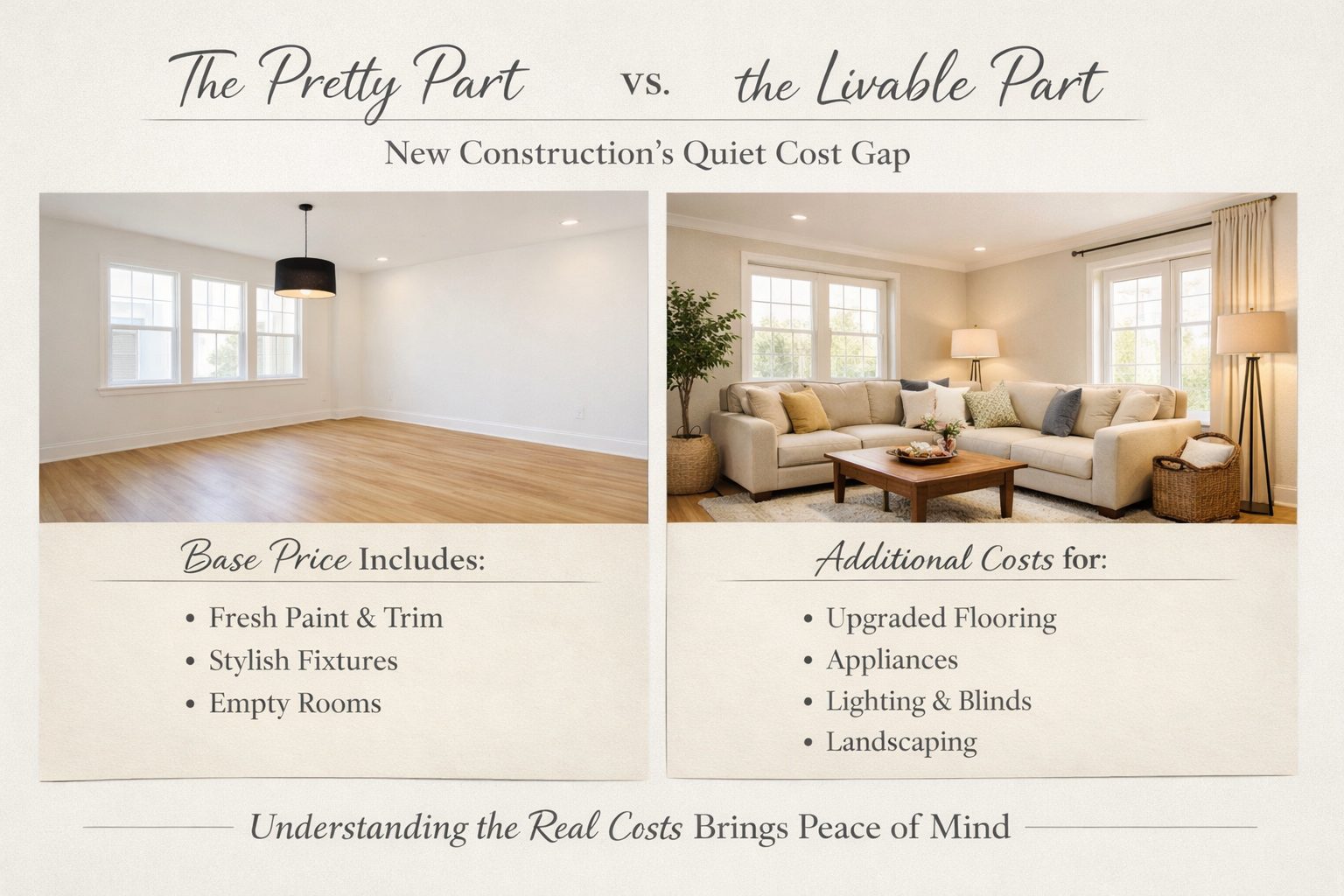
There’s a moment in almost every new-construction tour when the house feels done. Fresh paint. Crisp trim lines. That bright, echo quiet where your footsteps sound a little bigger than they should. You can already picture a sofa against that wall—maybe a warm rug, a lamp in the corner. And then—usually right around the time someone says, “So this is the base price?”—buyers get surprised.
Because the pretty part is usually what’s included. And the livable part often lives in the fine print.
Not in a scary way. Not in a “gotcha” way that means you should run. Just in the very normal way new construction works: it’s less a single purchase and more a sequence of decisions. And the earlier you understand the sequence, the calmer your whole experience becomes.
Below is the framework I use with buyers—especially the thoughtful ones who want to enjoy the process without feeling nickel-and-dimed later.
Big idea: New construction is a sequence, not a single yes/no
Most resale homes come with their “choices” already made. New construction hands you a pencil and says, “Now you decide.”
That can be exciting… until you realize how many decisions come before keys:
- what you choose now vs. what you can’t change later
- what gets priced as a “placeholder”
- what costs more after the fact
- what looks included in the model, but isn’t included in your contract
If you can see the sequence ahead of time, you don’t have to tense up at every design appointment. You just make fewer “surprise” decisions under pressure. To keep it simple, here are five practical “gotchas”—not to alarm you, but to give you a steadier grip on what “move-in ready” really means.
1) Allowances: “It’s included… until it isn’t.”
This is the most common surprise, and it’s usually not because buyers were careless. It’s because model homes are designed to make you feel something—and they often feature selections above the allowance.
Flooring, lighting, plumbing fixtures, appliances, cabinets… the model is a vision. The allowance sheet is the reality.
Where the cost sneaks in isn’t one big upgrade—it’s the way small choices stack:
- the light fixture you like is “just a little more”
- the cabinet pull is “only a few dollars each”
- the flooring upgrade is “not that much per square foot”
None of those lines feel dramatic on their own. Together, they can.
Calm move: ask for an allowance sheet early and walk through it like a grocery list—line by line—before you fall in love with the finishes.
2) Structural options: “Some choices are cheap—until they’re impossible.”
Paint can be changed later. Cabinet hardware can be changed later. But structural decisions—layout, window placement, ceiling height, added doors, extended patios—tend to be now-or-never.
And the tricky part is that these decisions often happen early, when you’re still trying to remember which way the sun hits the kitchen.
A common -buyer moment is this:
“We’ll live with it for now… and then we’ll adjust later.”
Sometimes that works. But if “later” means moving plumbing, reframing a wall, or relocating electrical? That “later” turns into real expense and real inconvenience.
Calm move: decide what needs to be right on day one. For most people, that’s flow (kitchen/living), storage, bedroom placement, and the spots where daily life piles up (mudroom, drop zone, pantry).
3) Site + lot costs: “The land has its own price tag.”
A base price is often tied to a specific plan—not a specific lot.
Lot premiums, view premiums, walkout basements, grading, retaining walls, extra driveway length, additional fill… these can be entirely normal in new construction, and they can also be the part buyers don’t mentally include when they say, “This fits our budget.”
If you’ve ever stood on a lot and thought, “This one feels right,” there’s a decent chance it costs more—because it’s doing something desirable: backing to trees, sitting on a corner, offering daylight in the lower level, giving you distance from neighbors.
Calm move: ask, “What does the base price assume?” (lot type, foundation type, grade) and “What changes on this lot?”
4) The “move-in” items: “You’ll be living there… but it won’t feel finished.”
This is the quiet gap that shows up after closing—when everything is technically livable, but daily life feels a little exposed.
Common examples:
- window coverings
- fencing
- sprinklers/landscaping
- garage finishing or openers (varies)
- appliances (varies)
- mailbox/address marker (varies)
- patio additions, decks, or privacy screens
These aren’t “luxury” items. They’re the things that make you exhale. And because they’re often outside the builder contract, they can become a second wave of spending—right after you’ve already spent a lot.
Calm move: create a Move-In Reality Budget—a short list of what you want done within the first 60 days so you can prioritize comfort without overspending.
5) Timeline + change orders: “The calendar is a cost, too.”
New construction timelines can shift for reasons that have nothing to do with you: labor schedules, inspections, weather, materials, sequencing. Most buyers understand that in theory. Where it gets stressful is in real life—when your lease end date, school schedule, rate lock window, or moving help is tied to a specific week.
Change orders can also carry added cost not just in pricing—but in timing. Some builders allow them; some don’t. Some require quick decisions. Some charge administrative fees. And some changes simply aren’t available after a certain point.
Calm move: ask early:
- “What decisions have deadlines?”
- “What happens if the timeline shifts?”
- “What can’t be changed once we sign?”
A simple way to use this: the “Before Keys” checklist
If you want one steady question to carry with you through the process, try this:
“Will I want this finished before keys?”
If the answer is yes, it belongs in your planning now—either in the contract, the budget, or the calendar.
And if the answer is no, you’ve just saved yourself from paying “builder pricing” for something you’re happy to handle later.
Closing thought
New construction can be a beautiful path—especially for move-up buyers who want a cleaner start, fewer repairs, and a home that fits how life actually runs right now.
You don’t need to be wary. You just need to be sequenced.
If you’d like, I can help you translate a specific community’s base price into a calm, realistic “move-in ready” picture—no pressure, just clarity.
Curious what the fine print would mean for your timeline and budget? Contact me and I’ll walk through it with you.


